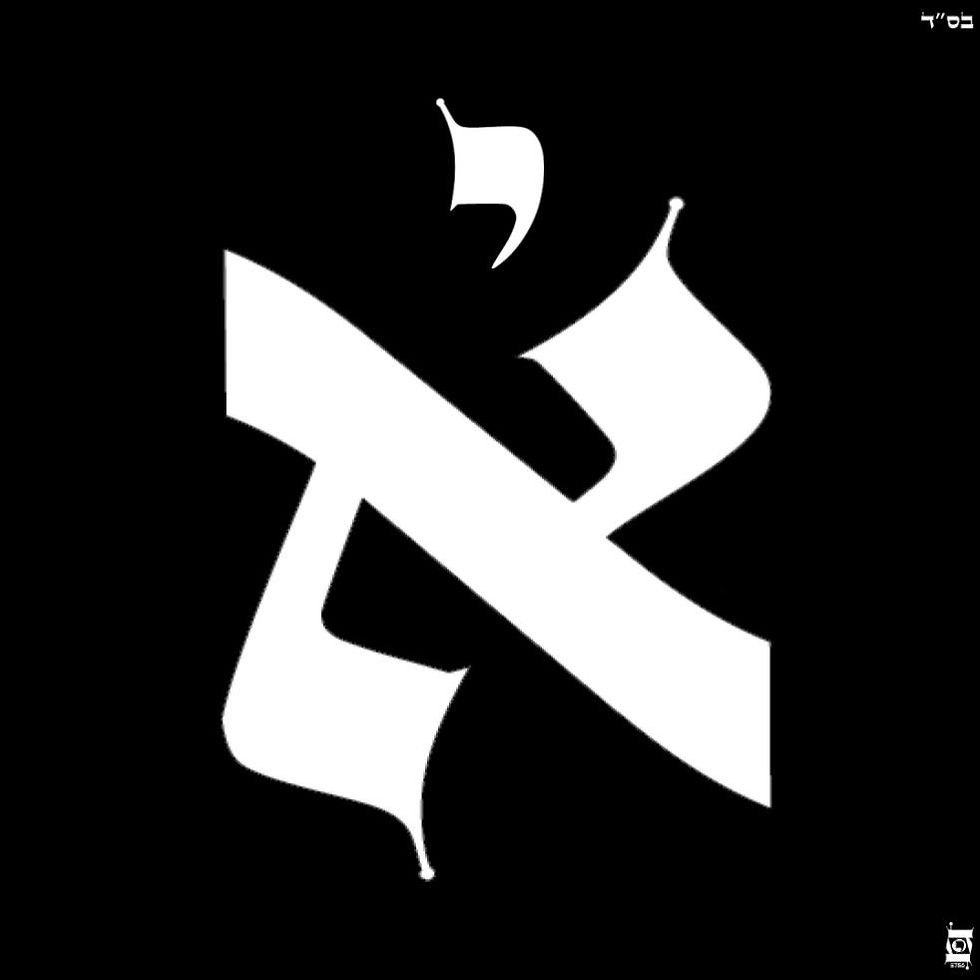
The Sound of the Letters

בס״ד
The Sound of the Letters — David’s Ten-String Harp, Based on 432 Hz
The meditative visualization videos published on this website until now have remained silent. This silence was not an aesthetic choice: no musical tradition for a biblical instrument had been found, and nothing was to replace it that would not remain faithful to this requirement.
WHL therefore began a different exploration, centered on a specific instrument: the harp. Not to add music to it, but to draw from it a sound that already belongs to the Letters themselves — derived solely from their structure, without any invented melody.
This choice is not a matter of aesthetic preference. The Talmud (Berakhot 3b) relates that a kinnor was suspended above David’s bed and that, at midnight, a wind would blow upon it and cause it to play by itself — an instrument resonating without being touched by any hand. Pirkei DeRabbi Eliezer attributes ten strings to the kinnor on which David played; Arakhin develops another tradition concerning the kinnor of the Temple and its 7, 8 and 10 strings according to the different times.
WHL retains ten strings here as an interpretive choice — a number that corresponds to the structure of the ten Sefirot, and to the same base-ten logic that already organizes the architecture of the system’s frequencies, from Yud through the tens and hundreds of the Alef-Bet.
The Hebrew Letters have already been offered to the gaze on this website, through their form and geometry. Today, they also have a voice.
The Sefer Yetzirah (2:1–3) already describes them in these terms: the twenty-two Letters are “engraved by voice, carved by breath, and fixed in the mouth in five places” — the throat, palate, tongue, teeth and lips. In this tradition, the Letter has never been merely a form: it has always been a precise and situated articulation of sound.
Each Letter is assigned its own frequency, calculated from a single fixed point: יוד (Yud, the tenth Letter), set at 432 Hz. From this pivot, the frequencies of all the other Letters are derived through simple mathematical ratios.
A melody implies a line unfolding through time; a Hebrew root does not unfold — it comes together, most often as three Letters united to carry a single meaning. It is this logic of combination, rather than succession, that has oriented this work toward harmonic vibration rather than melody: a base of ten for the architecture of the frequencies, and a base of three for the way in which Letters come together to form meaning.
The system comprises twenty-two Letters, complemented by their five final forms — the Sofit (ך ם ן ף ץ) — which close certain Hebrew words. Each of these twenty-seven sonic identities has been individually measured and calibrated in order to remain faithful to this mathematical basis down to the finest detail.
There are two levels of sound within this system.
The first is the pure sound of a Letter: its own frequency, alone, without ornament.
The second is the development of the Letter’s name. In Hebrew, a Letter bears a name composed of other Letters. The א (Alef) is written אלף — Alef, Lamed, Pe. These three sounds, brought together, form Alef’s harmonic cell and give it a depth that its frequency alone does not carry.
This idea of development has a name in the tradition: milui, the full spelling of a Letter through the Letters of its own name. The Chaar HaYichoud (51:29–32) expresses it in this way with regard to Yud: when it is pronounced as a complete word, its expansion is Vav-Dalet — יוד — and this expansion explains and unfolds what the initial point of the Letter already contained. It is this same logic that structures each harmonic cell in the system.
When several Letters come together to form a word, their developments do not follow one another like the notes of a melody. They meet, overlap, and this encounter creates for each word a sonic space of its own.
The calculation is based on a single principle:
f(Letter) = 432 Hz × the rational ratio specific to the Letter, with Yud serving as the fixed point.
This construction follows the gematric structure of the Alef-Bet in three blocks.
The first ten Letters, from Alef to Tet, together with Yud, define the system’s fundamental ratios.
The tens, from Kaf to Tsadi, each reproduce the matrix of their corresponding unit (Kaf = 20 reproduces Bet = 2) one octave lower.
The hundreds, from Qof to Tav, in turn reproduce their corresponding unit (Qof = 100 reproduces Alef = 1) two octaves lower — producing an intentional duplication: Alef and Tsadi thus share 288 Hz, while their identities remain distinct through the development of their names, rather than through pitch alone.
The five Sofit Letters follow the same rule without exception: their gematric values (500 to 900) correspond to an additional octave below their corresponding tens — Kaf Sofit from Hei, Mem Sofit from Vav, Nun Sofit from Zayin, Pe Sofit from Chet, Tsadi Sofit from Tet.
This system remains experimental, still undergoing sonic validation and listening — a working hypothesis, not a settled conclusion.
The Zohar (Introduction, 6:22) relates that when HM contemplated creating the world, all the Letters were still hidden — and that, two thousand years before Creation, HM was already contemplating them and playing with them.
Drawing from this image, WHL formulates its own working hypothesis: not to add music to the Letters, but to seek, through their architecture, the conditions for a resonance that might be their own.
It is therefore not music, in the sense in which we ordinarily understand it. It is a resonance, conceived to accompany silence rather than fill it — always in the service of meditative visualization, never placed before it.
Your reflections, feelings and perceptions are welcome.
©️ White Hebrew Letters — All Rights Reserved.
Original Hebrew letterforms, typography and visualizations. No copying, reproduction, modification or commercial use without prior written permission.
Original text in French. English translation produced with the assistance of Artificial Intelligence (AI). The French text remains the reference for the content, sources and their interpretation.