Shabbat Ki Tetze — Letter Hei 5786 — The Fifth Gate
Updated: Aug 26

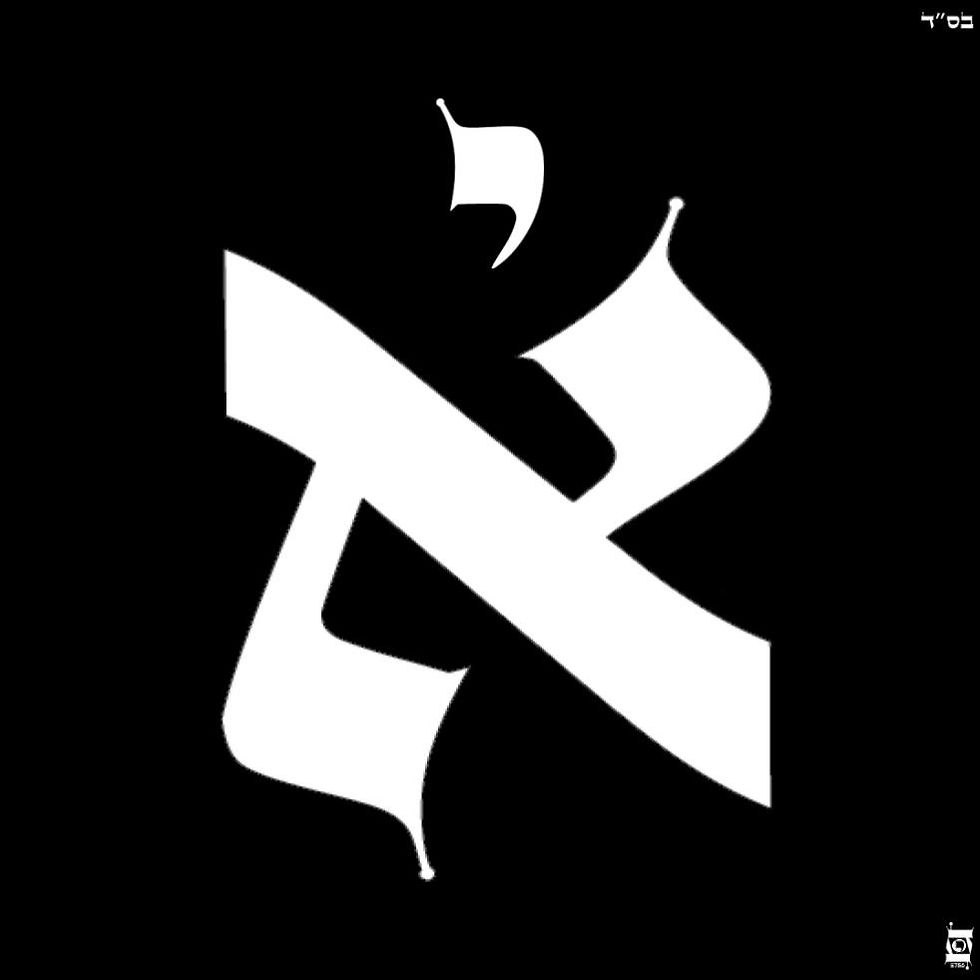
The morphology of the Hei reflects the Sacred Architecture of the Alefbet.Becoming aware of Its Sacred Singularity means returning to the Source of the Letter.Re-Cognizing each Letter in Its Sublime Beauty and Individuality can, for some, become a form of Prayer.The meditative visualization below, dedicated to the Hei, is an invitation to this journey:
בס"ד
The Hei as a Gateway to Adhesion (Dvekut)
The Baal Shem Tov explicitly teaches: “Even while speaking with another person, one should think of the Letters of the Torah — the 22 Letters are from the Holy One, Blessed be He.” The visualization of the Letters of the Torah is a constant practice, a path and a dwelling.
The Zohar expresses precisely this movement: when Israel “attaches” itself to the White Light from below,... the Dalet (the poor and separated Man) passes into Hei (fullness, union with G-d). The Letter Hei itself encodes this journey. Zohar, Bereshit 86 — Hei as blue/black light seeking the White Light
The White Color of the Letters in Meditative Visualization
The Torah: black fire upon white fire
The image of “Letters of black fire upon white fire” is an ancient tradition, taken up in Kabbalah: to contemplate the architecture of the Letter is to contemplate the very structure of the Divine within matter.
Chidushei Agadot, Eruvin 13a — the Torah: black fire upon white fire, foundation of the worldYerushalmi Shekalim 6:1
“The Letters were of black fire, covered with white fire.* White fire = Mercy (right), black fire = Severity (left).” The Torah unites the two. Zohar, Yitro 21:364–365
White fire and black fire are not opposed: they are complementary. To write the Letters in white on a black background is to dwell precisely within this polarity.
The Form of the Letters and Their Inner Meaning — The Letter Hei
The Sefer Yetzirah is the foundational book of the mysticism of the Letters: each Letter is a structuring world.
“He created them with the Letter Hei — beheh bera'am — this world is created through the Hei. The Letter Hei is square, whereas the world of nature is circular.
The Sefer HaBahir 27–29 establishes a connection between the two Hei of the Tetragrammaton — the double Hei: Upper Hei (Binah) and Lower Hei (Malkhut) — two Gateways to the Tetragrammaton.
Hei, level 5, is the 5th Letter of the Alefbet, the 5th Gate, the 5th Shabbat leading to Rosh Hashanah. It is the first occurrence in the Alefbet of a Letter belonging to the Tetragrammaton.
The Hei is the Letter of the space of connection and adhesion between Man and G-d, willed/desired by G-d.
A Morphological Reading of the Hei Formed from a Dalet and a Yud
The tradition of the Otiyot de-Rabbi Akiva teaches that each Letter carries within itself a spiritual anatomy.
The Hei is formed from a Dalet (this world, the dimension of a poor Man, insofar as he is distant from the Divine) and an inner Yud that does not touch the Dalet — because the transcendent cannot merge with the physical, but illuminates it from within. Derekh Chayim 5:1:11
The Hei as an Expansion of Understanding
The Tanya articulates precisely that the Hei represents “expansion in breadth and length” — Divine thought revealing itself and flowing downward. This connects with the idea of the berakhot poured forth through the Hei.
The Letter Dalet is stabilized by the Yud. The Dalet can/must lean upon the Yud. Moreover, the Yud below and to the left gives the Dalet a corridor of circulation and breathing. It rests upon the Letter Yud, the Letter of the essential Unity of G-d.
Reciprocally, the lower Yud of the Alef, present within the Hei, awaits the renewal and preservation of the bond with the Dalet. It awaits Adhesion to G-d through Man’s free choice.
The Letter Hei within Yud — Hei — Vav — Hei
The Letter Hei is the first Letter in the Alefbet that forms part of the Tetragrammaton, Yud-Hei-Vav-Hei. The emergence of G-d at the level of Man within the Alefbet.
Yosef Gikatila explicitly connects the Hei with overcoming impurity (orlah) and with adhesion to the Divine Name. The Fifth Gate deals with Binah and the Upper Hei (ה' ראשונה of the Tetragrammaton). Gikatilla explains there how passing through Binah is an ascent toward the root of the souls, a movement beyond the shell (kelipah — קליפה) toward adhesion (dvekut — דביקות).
Gikatila develops a vision central to our subject: the final Hei of the Tetragrammaton is the gateway to dvekut (our adhesion to the Divine). This becomes accessible precisely after passing through the four (Dalet) kelipot. It is the passage from impurity to Holiness — a structure that resonates directly with Ki Tetzei and the inner war that we must initiate against the yetzer hara — the side of evil.
“From the four external kelipot, we now enter in order to adhere to the Name Y-H-V-H, through the secret of the final Hei of His Name, which stands at the gate.” Sha'arei Orah §125 — R. Yosef Gikatilla (Fifth Gate)
“A person must strive with all his strength to grasp and adhere to the Name YHVH through His title Adoshem” — the Hei as a path to dvekut — adhesion to the Divine. Sha'arei Orah, First Gate §180
The Tikkunei Zohar 44b states that the first Hei of Y-H-V-H bears: “five colors, five lights that shine through them” — these colors form the luminous architecture of the Letter Hei itself at the highest level.
The Letter Hei and Its Kabbalistic Meaning at the Level of the Sefirot
In Kabbalah, the Hei represents Binah (Understanding) — the first Hei of the Tetragrammaton — or Malkhut — the Kingship Above (Keter) present below (the final Hei).
Hei is the Letter through which the world was created (“בְּהִבָּרְאָם” — “with a Hei He created them,” Bereshit Rabbah). Its form, open at the bottom, symbolizes teshuvah, the possibility of return.
The Tanya, Iggeret HaTeshuvah states that the path of teshuvah is a return through analytical understanding — Binah (ה' עילאה) — the understanding of the Letter Hei.
Thus, the two Hei of the Tetragrammaton: the first (Binah) receives all the Sefirot; the second (Malkhut) distributes the blessing to all beings. Gikatila — Sha'arei Orah, Eighth Gate §110
Meditative Visualization of the Letter Hei
White on Black, the Hei illuminates the Fifth Gateway of Entry. A profound understanding of the Hei is both a path toward adhesion to Yud-Hei-Vav-Hei and a means of coming to attach oneself to His Divine Plan.
Activating our intimate relationship with the Letters, through a profound knowledge of their Morphology and their Sacred Architecture, is a deep meditation, which is also a form of prayer.
The study of the Morphology of the Sacred Letters, and of the Letter Hei in particular, combined with the practice of visualizing Its Sacred Architecture, constitutes a proposal for meditative visualization.
“Through intense concentration on the Letters of the Torah, the Letters begin to shine and assemble... even an ordinary person can see wonders.”
The White Light emerges from contemplation — it is not placed there from the outset; it is the fruit of fixing the gaze.
The Letters connect black/white fire to the levunah (whiteness) of the higher mind: “what is black and low for the higher is beautiful and elevated for the lower”** — a key to the practice of meditative visualization.
The White of the page, of the parchment, is the direct metaphor of Atzilut: “The White shapes all the forms of the Letters without itself having any form.”***
The black Letters receive their life from the Whiteness that surrounds them — exactly the reverse of what the ordinary eye perceives.
The Letter Hei means Hineh, “Behold.”
Behold the Letter Hei, an act of gazing and connection between the Inner Breath and the White.
The Letter Hei is “the pure unvocalized breath, a light Letter without substance”* — the Hei as breath, hevel — the Letter pronounced without consonance, pure air.
A proposal for meditative breathing associated with the White — The White before the form.
Liberating and a Vector of Light.
Likutei Moharan 281:1; Likutei Moharan 192:1 — Rabbi Nachman;Baal HaSulam, Preface to the Zohar 28–29;Tanya, Iggeret HaTeshuvah 4:13–14
Sources to Explore
Study dedicated to the elevation of the neshama of Shneur ben Avraham z”l.
Original text in French. English translation generated using Artificial Intelligence (AI). The translation does not constitute independent verification of the content or sources. In case of any discrepancy or difference in interpretation, the original French text shall prevail.
©️ White Hebrew Letters — All Rights Reserved.Original Hebrew letterforms, typography and videos. No copying, reproduction, modification or commercial use without prior written permission.